

 If you are coming to the next World Cup, you might not think to ask the Simpsons for a restaurant recommendation in São Paulo. And yet, in a recent TV broadcast, the Simpsons are seen dining at an unnamed restaurant in São Paulo. Anyone who knows the São Paulo restaurant scene would immediately recognize the restaurant, A Figueira Rubaiyat (Rua Haddock Lobo, 1738, São Paulo - SP; tel. (11) 3087-1399; www.rubaiyat.com.br), a restaurant in the posh neighborhood of Jardim Paulista. The restaurant serves world-class meat and fish dishes under a 130-years´ old giant Banyan tree (Ficus benghalensis), a large relative of the fig tree native of India. In Portuguese, a fig tree is a figueira, which explains part of the restaurant name.
The other part of the name, Rubaiyat, is the name of the restaurant group that owns A Figueira Rubaiyat. The group has three restaurants in São Paulo, one in Brasília and two outside Brazil, in Madrid and in Mexico City. In 1951, Belarmino Fernández Iglesias arrived in São Paulo from Galicia, Spain, and began work in the restaurant industry, gradually moving up the ladder until becoming responsible for the meat grills of A Cabana, the best meat restaurant of that time. In 1957, he became a partner in a new restaurant, located in Vieira de Carvalho Avenue, in downtown São Paulo. The restaurant was named Rubaiyat in honor of the Persian poet Omar Khayyan, whose poems gave a prominent place to wine.
 |
Scene from the Rubaiyat Illustration by Edmund Dulac |
"Did God set grapes a-growing, do you think,
And at the same time make it sin to drink?
Give thanks to Him who foreordained it thus--
Surely He loves to hear the glasses clink!"
from Omar Khayyan´s Rubaiyat
Belarmino´s restaurant group remains true to its roots. Although it also offers fresh seafood flown from Santa Catarina and Argentina, it is best known for its delicious meat cuts that are sourced from a ranch in Dourados, Mato Grosso, the Rubaiyat Ranch, acquired in 1968. The ranch has crossed the well-known Angus breed with the more resistant Brahman to produce the Brangus cattle, which is grass-fed to produce the excellent cuts of meat used in the restaurant. Recently the ranch has also began raising Kobe (Wagyu) beef.
 |
| Bar |
The wine cellars of A Figueira Rubayat—and of its sibling Baby Beef Rubayat)—are impressive. In 2013, Wine Spectator placed both restaurants in its list of Restaurant Awards, including the “Best Awards of Excellence” give to restaurants that offer more than 400 wines, including great wines from the most important wine regions of the world.

Our last visit to A Figueira Rubaiyat was in November 2013. The restaurant catches your eye right from the start. To begin, the enormous Banyan tree is wonderful and the architect Fernando Iglesias, one of Belarmino´s sons, found a perfet way to integrate the tree in the architecture of the restaurant. The tables are placed under this magestic tree. You are indoors, but you have the feel of the outdoors. The tables and chairs are made of leather and ipê wood, the national tree of Brazil.

The restaurant is far from small, but we hate to be kept waiting for a table, so we made a reservation for 8:30 p.m. When we arrived the restaurant was almost complete, but there were still a few empty tables. There were business groups, tourists, romantic couples, families visiting from the interior of the state, all sorts of people. Nevertheless, the service is very efficient, in fact, too efficient, we had the impression that our meal took place in a breakneck pace.
 |
| Couvert |
To start with, we ordered the couvert, a series of tidbits that restaurants in Brazil offer (at a price) to wet your apetite and entertain you while you are having a drink or studying the menu. The couvert at A Figueira Rubaiyat is substantial: Spanish chorizos, mozzarela di buffala, carpaccio of zuccini with mint, fresh salmon baked in a wood stove, and different house-made breads, including our favorite, pão de queijo. After munching on these treats we decided to skip starters and go directly to the main dishes, a good strategy since we found out that the portions at A Figueira Rubaiyat are fairly copious.

Chantal chose a picanha summus, an exclusive cut of beef, made from part of the rump (rump cover or rump cap). Variations of this cut are very popular in Brazil for their intense flavor. The picanha was accompanied by cogollos de Tudela and batatas ao murro. Cogollos de Tudela is a type of lettuce grown in the community of Tudela, Spain. It is bitter and crispier than the normal lettuce with smaller leaves and is normally served split in four. Batatas ao murro, are potatoes cooked with their peel and smashed, that is, pressed down so that their peel busts open. A tray with three different sauces was brought to our table for us to try: a herb sauce, a pepper sauce and a “salt” sauce. Chantal enjoyed her meat, including all three sauces, but felt that there was nothing special about the potatoes.
 |
Picanha summus e cogollos de Tudela |
François had a filé mignon de pedreiro marinado em alecrim e azeite de oliva com batatas suflés. The filet mignon is marinated for 24 hours in rosemary and olive oil and then grilled. The meat ends up tender and with a wonderful flavor. Its is accompanied by soufflées potatoes, which are fried twice in oil, first at a temperature of 200°C and then at 300°C. The potatoes become puffed up, crisp on the outside and hollow inside. Highly recommended!
 |
| Filet mignon marinated in rosemary and olive oil |
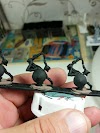
 It is worth mentioning that the restaurant makes a big effort to serve the meat cooked precisely to the customer requirements. Small metalic cows, quite cute, are stuck to the meat cut indicating whether they should be well-done, medium, or rare.
To accompany our dinner we chose a French wine, Crozes-Hermitages, Les Meysonniers Bio 2008, produced by L. Chapoutier with sirah grapes. French wines tend to be expensive in Brazil, so we thought ourselves lucky to find such a good wine for R$122, the equivalent to about US$53 a bottle.

For dessert you have plenty of choice. You can either chose from a dessert buffet or you can order à la carte. Aware that the dessert buffet is quite tempting and afraid to overindulge, we ordered à la carte, but to tell you the truth, in the end, prudence lost to gluttony anyway.
 |
| Dessert buffet Photo: Trip Advisor |
Chantal had a turrón de almendras, a nougat ice cream and François a petit gateau with vanilla ice cream. Petit gateau is the name used in Brazil for molten chocolate cakes. Both were good, but there are plenty of other choices. Keep this in mind when you are enjoying the first part of your meal and go slow on the delicious soufflées potatoes.
 |
| Nougat ice cream |
 |
| Molten chocolate cake with vanilla ice cream |
To finish the meal we ordered two expressos. They came accompanied by a plate of petit fours, which might be considered a dessert option for those who did not follow our advice to take it easy on the meat and potato front. The total cost of the dinner for two, including gratuity, taxes and wine, was R$482 or the equivalent to about US$210.
 |
| Petits fours |






0 Yorumlar